 You’ve decided to work with an executive coach to help with your career goals or professional development, and now you’re focused on setting goals for executive coaching.
Now what? The platform of executive coaching is created from your goals, and establishing these goals is the first step towards your success.
Executive coaching will often start with the creation of a three-tier plan as part of the executive coaching process.
The first tier focuses on the question, “Where do you want to be?” The answer to this question creates your top-tier vision, the overall accomplishment you want to achieve, which coaching will facilitate.
Once your vision is clearly defined, an executive coach will help you establish your executive coaching goals towards that vision. The goals on tier two break down the vision into manageable pieces, ensuring they align with effective executive coaching goals.
As you focus on one or more goals at a time, you are moving forward towards the accomplishment of your vision while also enhancing your leadership skills and communication skills. To move forward, however, you need more than the “what” defined by your goals; you also need a “how”; tier three addresses this.
How Setting Goals For Executive Coaching Helps?
Each goal is analyzed to determine action steps to achieve the goal. You work through your action steps to accomplish each goal, which will result in the attainment of your vision.
Goals must meet certain criteria to be successful:
- Your goals should be articulated in specific terms to help with the action steps.
- They should also be measurable to provide evidence of your progress or to reevaluate if the action steps aren’t working.
- Goals should be realistic regarding time frame and resources.
- Finally, successful goals are relevant in terms of your values and vision, and they should be based upon a timeline to encourage prioritization and to keep you motivated.
Related article: Being Ambitious and Goal-Oriented Does Not Make You Selfish
As part of goal setting, the executive coach may also assess your strengths and how these can be utilized in the action steps. The strength analysis will also help define how these characteristics and skills can help with any challenges hindering goal attainment.
 There are different ways in which individuals set goals in executive coaching. Very often, after a quarterly or annual performance review, an executive becomes aware of areas for development, and the coaching goals are based on what the executive wants to work on towards self-improvement.
In addition, an executive might already have an awareness of their professional vision for themselves or their organization, and the goals can be structured from that vision.
Goals can also be established together with your coach. Information from the executive’s role, professional feedback, or structured assessments can help you and your coach determine the challenges that resulted in the data. Goal setting is then focused on how to improve those areas directly connected to your vision.
Finally, goal setting could be company-directed. An organization might hire a coach to work with an executive. This might come after a poor review or as part of a performance improvement plan.
In this scenario, the goals will likely be based on the organization’s vision versus the executive’s vision. The organization will then use the goals to ascertain the executive’s progress.
Related article: Harnessing the Power of Change
The Role of Executive Coaches in Driving Growth
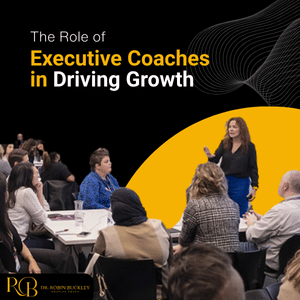 Executive coaches provide more than advice; they guide coaching clients through tailored strategies that strengthen leadership capabilities while aligning with organizational priorities.
Unlike traditional training, leadership coaching is highly personalized and designed to address the unique challenges executives face.
Through carefully planned coaching sessions, business leaders can build self awareness, refine leadership presence, and make progress toward executive coaching goals executives set at the beginning of the partnership.
This individualized approach ensures that every coaching effort ties back to organizational objectives and contributes to both personal and organizational success.
Enhancing Leadership Through Structured Coaching Engagements
An effective executive coaching engagement gives senior leaders the opportunity to grow beyond daily responsibilities and sharpen their ability to lead.
In a coaching session, executives often work on developing high performing teams, enhancing communication skills, and improving communication skills that strengthen collaboration. Each team member benefits from a clearer understanding of their role and how to contribute to collective success.
These sessions are also used to build strategic thinking and emotional intelligence, along with conflict management skills, which are critical in decision-making and leadership performance.
Related article: Executive Coaching and Cultivating a Growth Mindset in Leaders
Working with a skilled leadership coach ensures that professionals in leadership positions gain the tools and insights necessary to align personal growth with individual and organizational objectives.
By focusing on leadership development, coaching clients can make lasting changes that improve team performance and directly support organizational goals.
The results are not just stronger leaders but also healthier cultures that promote a healthy work-life balance and sustainable growth.
Aligning the Coaching Journey with Well-Defined Goals
 An executive coaching partnership begins with a coaching journey that emphasizes clarity and purpose. Setting well-defined goals allows the coaching process to remain focused, ensuring that leaders balance personal goals with the broader mission of the company.
Throughout this journey, coaches support leaders in managing stress, applying conflict resolution techniques, and refining their executive presence so they can effectively inspire teams.
This process creates a foundation for sustainable success, where both individual achievement and the organization’s success are closely linked.
By learning how to track progress, executives can see meaningful progress in their leadership development while preparing to tackle complex challenges with confidence.
Related article: You Don’t Have to Sacrifice Your Career Goals to Prioritize Your Family
Driving Organizational Growth Through Coaching Outcomes
Executive coaching is more than self-improvement; it’s about creating measurable organizational outcomes that fuel long-term impact.
By enabling leaders to develop a growth mindset, organizations gain a competitive advantage in today’s demanding markets. Coaches work closely with key stakeholders to align coaching strategies with company priorities, leading to stronger business results.
This approach not only enhances team productivity but also encourages fostering innovation, building resilience, and supporting professional growth for both established executives and high-potential employees.
Ultimately, coaching interventions contribute to organizational growth by preparing every business leader to deliver results that matter while ensuring the company thrives in a changing environment.
Real-World Impact of Executive Coaching
 There are countless examples of executive coaching producing measurable results in organizations across industries. For instance, coaching efforts can support succession planning by preparing emerging leaders to step confidently into new roles.
Leaders who focus on building confidence and leadership presence during coaching sessions often become role models for their team members, inspiring top-performing teams to thrive.
Leadership coaching has also been proven to help executives align with organizational objectives, which ensures that leadership performance advances organizational goals and organizational success.
By developing high-performing teams and balancing organizational priorities, executive coaching becomes a game-changer for both the individual leader and the broader company.
Related article: Thriving Under Pressure for Peak Performance
When you work with an executive coach, your experience is not going to be like past training or continuing education opportunities. Executive coaching is individualized to help you develop the effective leadership skills that you need.
It is your time to focus on yourself and where you want to be. Articulating your ideal vision in coaching is an appropriate approach, not just a pipedream, and is essential when setting goals for executive coaching.