Every time women start taking up more space, culture seems to develop a sudden, urgent interest in making us smaller. Funny how that works, especially when it comes to beauty standards and women.
Women get more political power, more sexual freedom, more financial independence, more professional visibility, and suddenly the ideal body looks like it has been living on black coffee, stress, and the emotional support of a celery stick.
Twiggy. Heroin chic. Ozempic thin. Different decades, different packaging, same little whisper: Be powerful, but not too visible. Be free, but still pleasing. Be successful, but don’t take up too much room at the table. And while you’re at it, could your thighs maybe apologize for your ambition?
Beauty Standards and Women: Our Choices
To be clear, this is not about blaming women for wanting to look a certain way. Women are allowed to want things. We are allowed to enjoy beauty, fashion, health, strength, sex appeal, great jeans, red lipstick, cheekbones, whatever makes us feel like we are walking into the room with the appropriate amount of main character energy.
But we also have to be grown-ups about this. Desire does not happen in a vacuum. “I’m doing it for myself” can be true. It can also be conditioning with better grammar.
Because where did we learn what “better” looks like? Where did we learn about beauty standards and women? Who gets rewarded for achieving it? Who gets ignored, mocked, dismissed, or punished for refusing it? And why does the acceptable version of a powerful woman so often come in a smaller, younger, tighter, more controlled package?
That is the part worth examining.
Beauty Standards Are More Than Trends
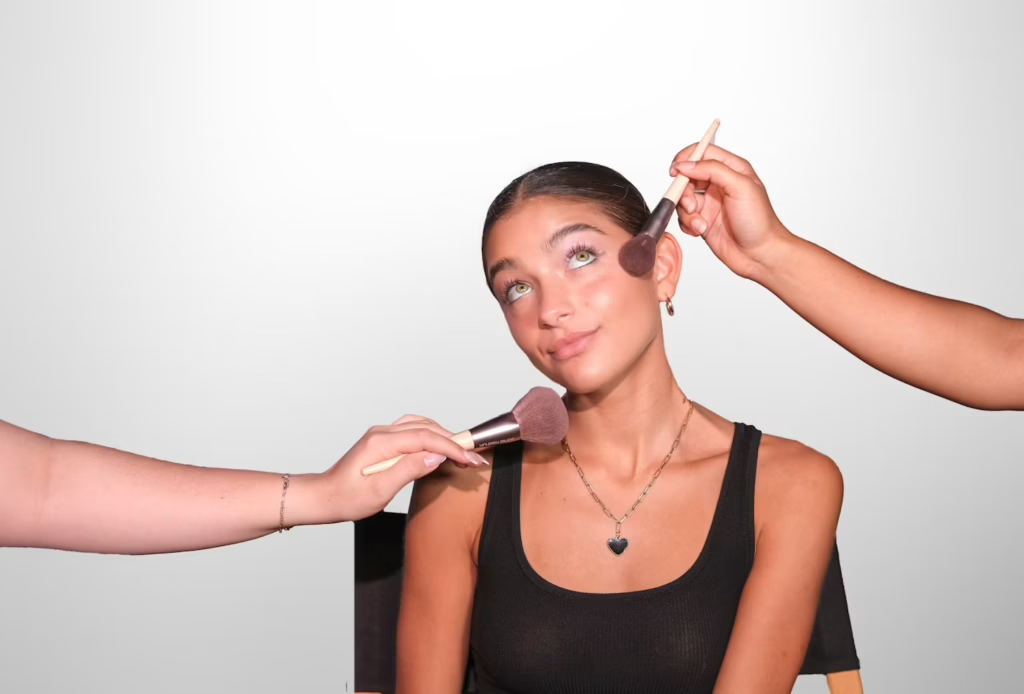
Beauty standards are not just trends. They are instructions. Sometimes they tell us how to look. Sometimes they tell us how to behave. And sometimes they tell us how much of ourselves the world is willing to tolerate.
In the 1960s, as women were demanding more freedom, more access, more voice, fashion elevated an ultra-thin, youthful, almost adolescent ideal. In the 1990s, when women were working more, earning more, and claiming more cultural and sexual power, heroin chic sold depletion as elegance. Nothing says “liberated woman” quite like looking like all your needs have been surgically removed.
And now we are in the era of wellness thin. Optimization thin. “I just care about my health” thin. Sometimes that is true. Sometimes health is health. And sometimes beauty standards and women is diet culture wearing linen and carrying a very expensive water bottle.
The Psychology Behind Beauty Standards and Body Image
This is where the psychology matters.
Human beings respond to rewards. Compliments. Attention. Approval. Belonging. Dating value. Professional polish. Social media validation. We like to pretend we are immune to those things because we are smart and independent and have read at least three Brené Brown quotes. But our nervous systems are not made of granite. If a culture repeatedly rewards women for being smaller, quieter, smoother, younger, and easier to visually consume, women will learn the assignment.

Why High-Achieving Women Can Turn Their Bodies Into Another Metric
And high-achieving women? Oh, we are especially vulnerable to making the body one more damn performance review.
Because if thinness gets coded as discipline, control, elegance, success, and moral superiority, then the brain hears, “Excellent. Another metric.” Suddenly your body becomes a project. Your meals become data. Your workouts become proof. Rest feels suspicious. Softness feels like failure. Pleasure needs to be earned. Aging becomes a problem to solve instead of a life to inhabit.
That is not empowerment. That is anxiety with a better outfit.
When Pursuing Health and Beauty Starts Making Life Smaller
And yes, there is room for nuance here. Wanting to feel strong in your body is not the problem. Caring about your health is not the problem. Wanting to look good is not the problem. The problem is when your life gets smaller in the name of making your body smaller. The problem is when your energy, creativity, sexuality, humor, leadership, and joy all get funneled into the exhausting job of being acceptable.
The problem is when you start using your body as a public relations strategy.
“I’m ambitious, but don’t worry, I’m still tiny.”
“I’m powerful, but look, I’m controlled.”
“I’m aging, but I promise I’m fighting it.”
“I have needs, but I’ll make them look decorative.”
No. Your body is not the apology note for your ambition.

How to Question the Cultural Script Around Your Body
I know this is hard because the pressure is not imaginary. Women are judged. Bodies are evaluated. Aging is policed. Weight is moralized. Appetite is monitored. Desire is complicated. The algorithm is a tiny goblin that learns your insecurities and then serves them back to you with a discount code.
So this is not about pretending you can just wake up tomorrow, throw on confidence like a blazer, and become magically unaffected. That is not how conditioning works. Conditioning loosens when we notice it, question it, and stop confusing compliance with freedom.
Start there.
Notice when “health” expands your life and when it shrinks it. Notice when a goal gives you energy and when it turns you into your own parole officer. Notice when you are caring for your body and when you are trying to make it more tolerable to other people. Notice when beauty feels playful and when it feels like obedience.
That pause matters. It creates space between the cultural script and your actual choice.
Real Empowerment Means Giving Yourself Permission to Take Up Space
Because real empowerment is not just choosing from the menu you were handed. Real empowerment is asking who wrote the menu, who profits from it, and whether you even wanted to eat there in the first place.
Women are allowed to take up space. Physically. Emotionally. Politically. Sexually. Professionally. At brunch. In boardrooms. In relationships. In photographs. In aging bodies. In loud laughter. In soft bellies. In strong legs. In changing skin. In full lives.
The goal is not to become careless with your body. The goal is to stop making your body carry the burden of everyone else’s comfort.
Let the room stretch. Let the culture catch its breath. You do not have to shrink your body to earn the right to expand your life.
Ready to Create Change on Your Own Terms?
Understanding the expectations you have absorbed is one thing. Learning to separate those expectations from what you actually want can be harder. Coaching can help you identify the beliefs, patterns, and internal pressures shaping your choices—and create a healthier definition of success that reflects your values rather than someone else’s expectations.
If you are a high-achieving woman who wants to examine the patterns influencing your confidence, identity, relationships, or sense of self, Dr. Robin Buckley offers executive coaching designed to help you create meaningful change without shrinking yourself in the process.
Ready to define success on your own terms? Reach out to book your session with Dr. Robin Buckley.